

Child Safe Framework
Canterbury supports the rights of children and young people and is committed to ensuring the safety, welfare and wellbeing of our students.
This commitment is embedded in the College’s organisational leadership, governance and culture.
It also includes the provision of a safe and supportive learning environment for all students, and requires that all employees, volunteers and visitors model and encourage behaviour that upholds the dignity and protection of our students from any harm.
To uphold this commitment, Canterbury maintains a comprehensive Child Safe Framework. This framework brings together our policies, procedures, reporting processes and ongoing training to ensure the safety and wellbeing of every student in our care remains a core priority in all that we do.
Policies & Procedures
Our policies and procedures below clearly define all actions to be taken if a staff member or College parent becomes aware, or reasonably suspects, that one of our current students under the age of 18 has been harmed, or is at risk of harm, by people outside the College, a staff member, or other students.
Statement of Commitment
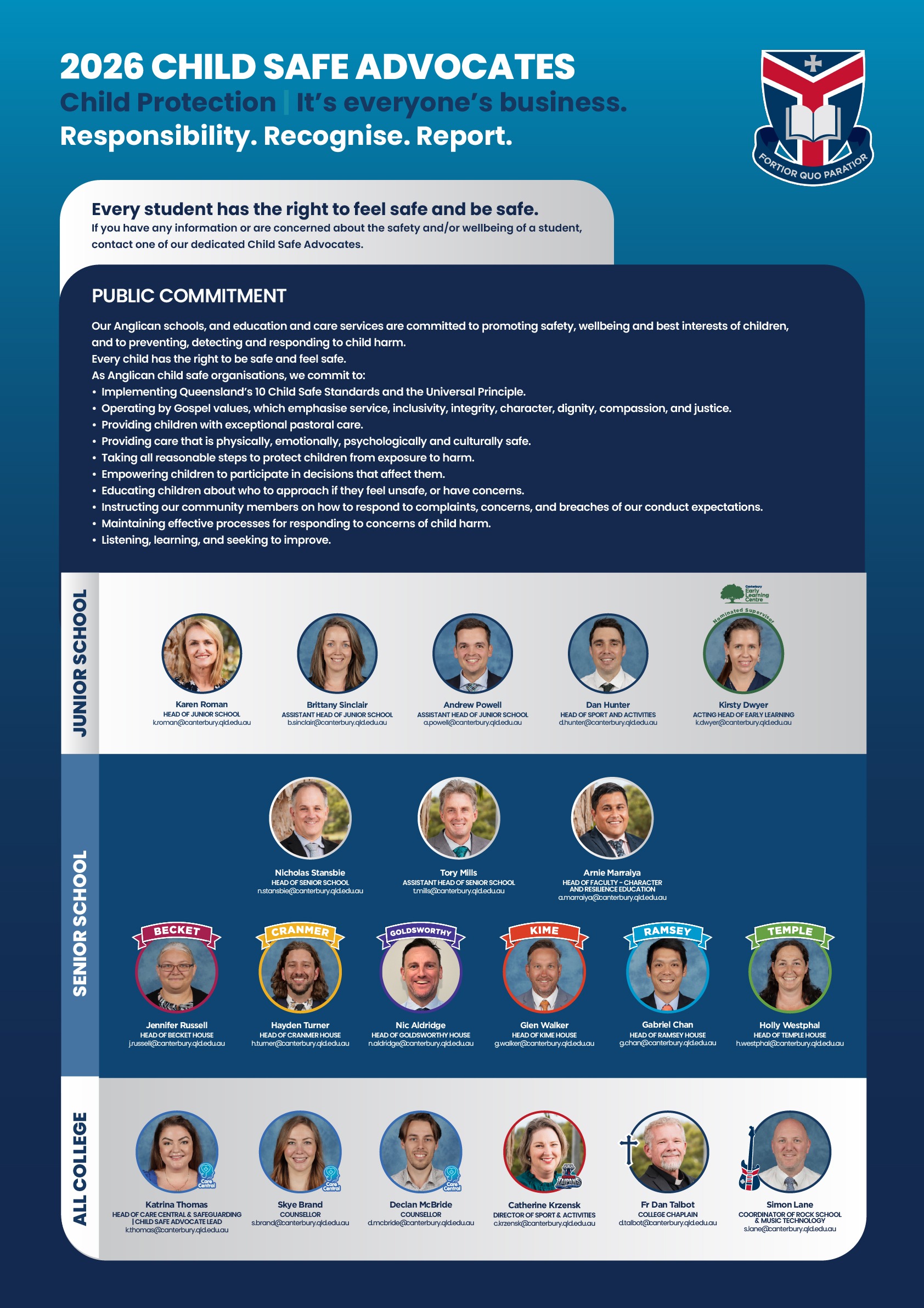
Our Anglican schools, and education and care services are committed to promoting safety, wellbeing and best interests of children, and to preventing, detecting and responding to child harm.
Every child has the right to be safe and feel safe.
As Anglican child safe organisations, we commit to:
- Implementing Queensland’s 10 Child Safe Standards and the Universal Principle.
- Operating by Gospel values, which emphasise service, inclusivity, integrity, character, dignity, compassion, and justice.
- Providing children with exceptional pastoral care.
- Providing care that is physically, emotionally, psychologically and culturally safe.
- Taking all reasonable steps to protect children from exposure to harm.
- Empowering children to participate in decisions that affect them.
- Educating children about who to approach if they feel unsafe, or have concerns.
- Instructing our community members on how to respond to complaints, concerns, and breaches of our conduct expectations.
- Maintaining effective processes for responding to concerns of child harm.
- Listening, learning, and seeking to improve.